
In tonight’s concert, the Philadelphia Orchestra placed the baton in Polish conductor Anna Sulkowska-Migon’s award-winning hands and left their usual repertoire of American and Western European composers on a journey to the East… only to find pieces that borrowed heavily from western compositional themes and structure.
I would describe Ms. Sulkowska-Migon’s conducting style as buoyant, and leaning heavily into the dynamics and emotion of the pieces. Though her direction was clear and easy to follow from our seats, it took a bit for the orchestra to sync into each piece.
Our journey first stopped in Poland to play the Overture from the country’s national opera. Felix’s Nowowiejeski’s Baltic Legend tells the story of a princess angering her heathen gods and bringing down their wrath on her people. If you listen carefully you will hear openly plagiarized themes from Brahms and Beethoven paying homage to their great lyricism before turning the tune to original variations. The orchestra started loud and moved to fff in the piece, a volume usually reserved for the Canons in the War of 1812. The speed of the musicians was incredible during the rapid arpeggios and scales demanded by the composer.
Our trip next visited China to hear a piece from the country’s most famous film score composer, Zhao Jiping. His second pipa concerto brought the musical flavors of Asia into the heart of Philadelphia. The composer did a brilliant job of allowing the soloist to shine by limiting the amount of orchestration during the solo parts, relying more on dialogue and minimal scoring.
The piece was actually commissioned for the soloist who played this evening, Wu Man. Watching her play was a unique pleasure, and the orchestra gave her the space to shine. This piece proved the highlight of our journey. The virtuosity of Wu Man can the beauty of the early scoring planted a little piece of our hearts in Asia and left us longing for more. She even managed to fix her instrument mid piece when a string came loose. Towards the end of the song the composer moved to more western sounds and scores—almost something one would expect to hear in a James Bond film score. The cultural range of the piece seemed to circle the globe by the time the piece finished.
Our journey concluded with Tchaikovsky’s popular Symphony No. 5. Perhaps the most emotionally stirring piece amid the ocean of Tchaikovsky’s moving masterworks, this piece is an excellent littenus test for technically brilliant orchestras; it serves as a brutal test of the conductor’s interpretation and the orchestra’s capacity. This piece’s style and structure is often mimicked by later composers such as Rachmaninov in order to stir emotions. I did not feel Ms. Sulkowska-Migon’s approach to the piece let it breathe enough to build the innate emotion available in the lyrical sections. The choices of speed and tambour in the first movement felt more Russian—which Tchaikovsky may have appreciated—than other modern interpretations. It felt more ominous and warring than many of the popular recordings of it over the last 50 years. This lessened in later movements, but that perspective is a matter of taste.
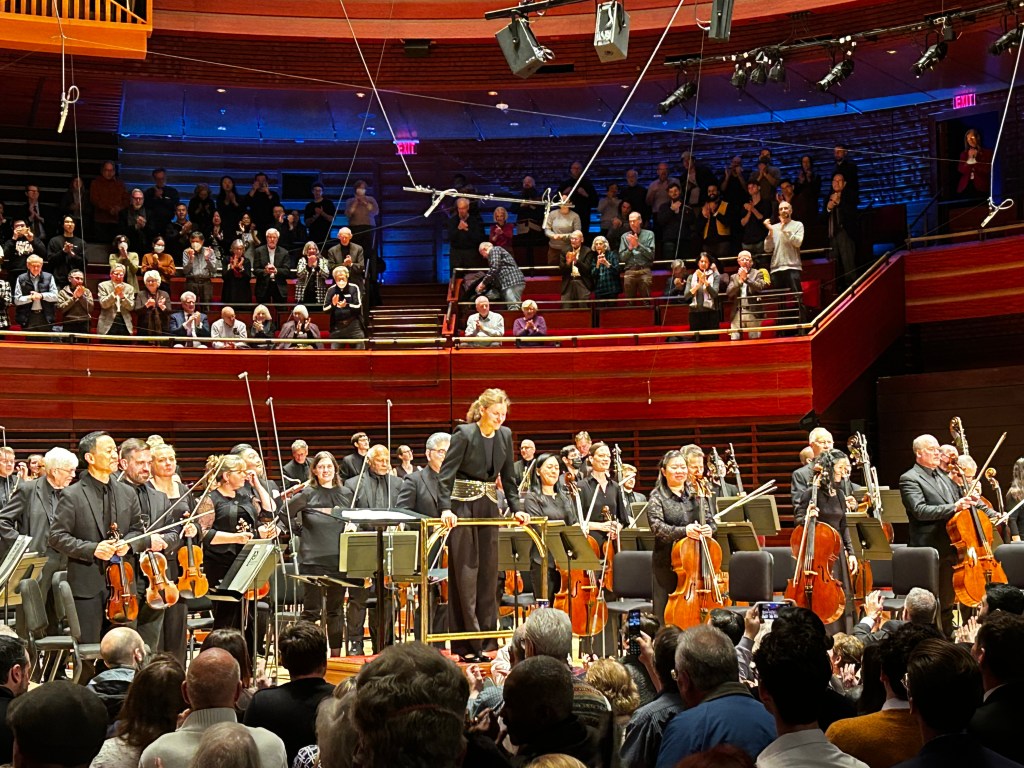
As always, you can determine if you agree with our analysis or not simply by tuning in to WRTI.org on Sundays at 1 p.m. EST to hear concerts replayed throughout the year. Though, if you never make it out to Verizon Hall you will miss out on the power and warmth that a full-bodied live orchestra in an acoustic architectural sound stage can provide.
The Philadelphia Orchestra has proved their mastery in precision over the last two years and their capacity with many emotive moments moving the audience under Yannick’s baton. Each time a guest conductor leads they bring variation and flare to the offering, yet there is something that I feel always seems to drop a bit in their razor-sharp precision under Yannick.
Regardless, The Philadelphia Orchestra simply continues to provide performances the pinnacle performances of our time, look no further than the Grammy Awards for consensus option on such matters.
*we were invited to facilitate a feature, all opinions are our own*



 the mommy avenger
Leave a comment