The New Jersey Symphony first night on a three night concert tour provided a peaceful and engaging distraction from the challenges of work and life. The first night of the mini-tour found us at the New Jersey Performing Arts Center in Newark, where the orchestra demonstrated the fanciful and buoyant nature of the selections. On Saturday, the symphony will be at the Count Basie Center for the Arts in Red Bank and on Sunday, they will perform at the State Theatre in New Brunswick.
Xian Zhang, principal conductor of the symphony, put together a series of pieces designed to stir the heart and take the mind elsewhere. She went to her bench for the soloists, using Robert Ingliss to perform gymnastics on the oboe and Eric Wyrick to lead out in the ever-popular The Four Seasons.
The concert began with Reena Esmail’s pandemic composition. The piece sought to promote joy amid the uncertainty of the time by testing the skills and range of the principal oboe player. The oboe played sweeping melodies in counterpoint to the orchestra’s frenetic dissonance and intensity.
Following that portrait of peace amid difficulty, we were treated to Richard Strauss’ departure from the traditional concerto model in favor of a more postmodern work. In spite of being composed after World War II, with Strauss’ homeland lying in rubble, this piece embodied the very idea of hope.
After these pieces, Robert Ingliss performed an encore I do not recognize, but that the audience loved.
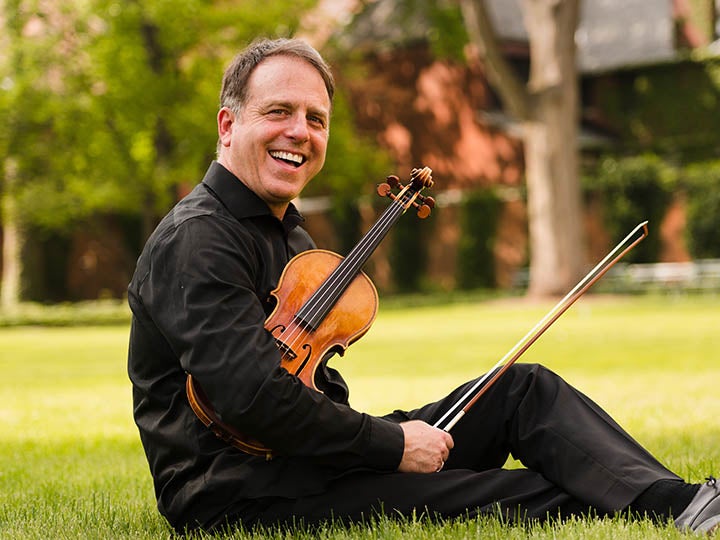
After testing Robert Ingliss’ endurance and mettle, the symphony trimmed down to sixteen musicians to perform a piece that needs no introduction among concert-work aficionados, Vivaldi’s The Four Seasons. Eric Wyrick led the ensemble as soloist; they largely kept pace with his direction. His performance was excellent, enhancing the piece with his interpretation of the dynamic emphasis. His approach broadened the range of the accents in a way that I quite enjoyed.
Of course, I am a sucker for program music (music that tells a story or puts the mind in a narrative state), so I enjoy hearing this piece and trying to discern the different ideas that he hints at during his depiction of spring, summer, autumn, and winter. In different parts of the piece, one can hear dogs bark, sheep grazing while a shepherd sleeps, birds singing, a storm rolling in, flies and hornets swarming, hunting guns, fleeing deer, and can feel the frigid wind of winter, ice cracking on a pond, or even sense the warm heat of a fire or an oppressive summer storm. The ensemble played their best during the summer movements.
This would be a fantastic concert to bring those less experienced in classical music or mature youth in order to introduce them to concert music. As mentioned earlier, two more performances will be available if you would like to lift your spirits or share beautiful music with friends or loved ones.
*we were invited to facilitate a feature, all opinions are our own*



 the mommy avenger
Leave a comment