
The thing about great organizations, companies, and sports teams is the tendency toward ascendency; those with skill, talent, ideas, and monumental potential seek association and collaboration with such entities. This elevates the status and skill of both parties. As long as the key ingredients to the organization’s success remain in place, they will continue to the top of their field or increase their dominance at the top.
For example:
- Philadelphia Orchestra, check.
- Yannick Nézet-Séguin conducting, check.
- Grammy winning Dame guest performer, check.
- Balanced, entertaining classical and modern repertoire, check.
It is by this principle that the Philadelphia Orchestra continues to improve as (in our opinion) the world’s current greatest standing orchestra.
Want evidence? Come to the Kimmel Center. Hearing is knowing. If you can’t make it, tune in to WRTI.org at 1 pm Eastern on Sundays to hear the Grammy award-winning level recordings that are as common to these musicians as eggs in a chicken coop.
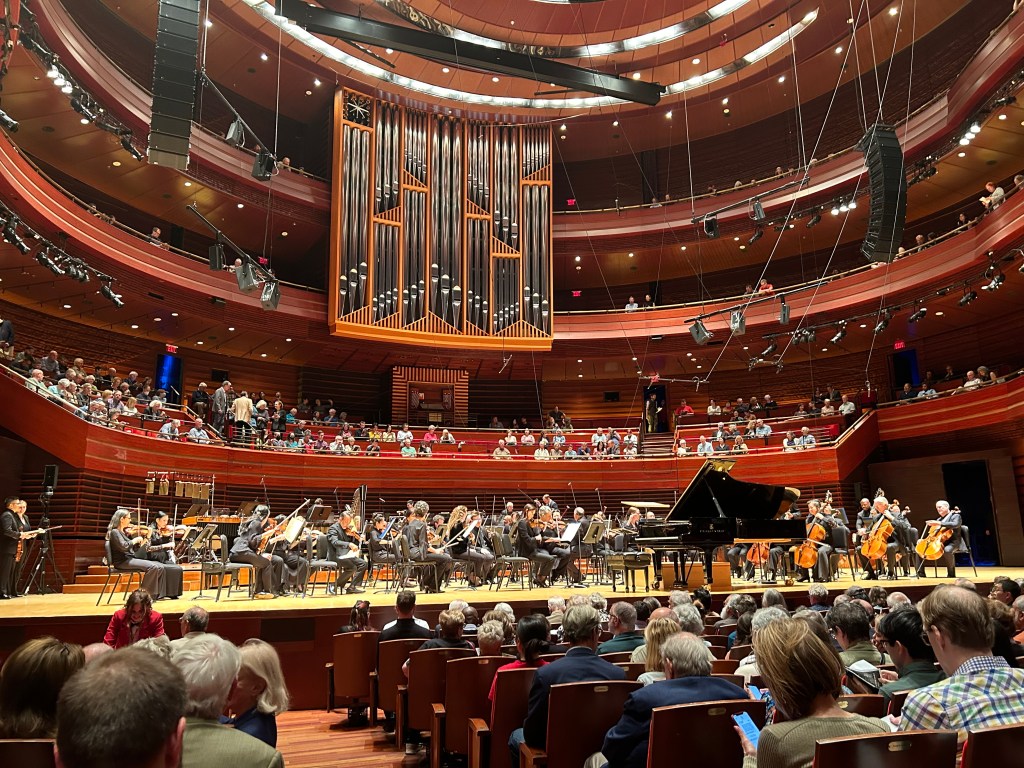
With that introduction, or if you have followed this blog for the last two years, you can probably guess where we were tonight.
The concert started with Ravel’s Piano Concerto in G Major. Uncharacteristically, it took a few measures for the orchestra to sync up and hit their normal stride. By the end of the first movement, Yannick had balanced the orchestra and soloist and no missteps followed.
It was not until we got the concert program that we realized that Dame Commander of the Order of the British Empire Mitsuko Uchida is 75 years old. This classical music matron can still put on a performing master class for young professionals in the field. It’s not about flashy couture dresses or exaggerated movements. It’s the timing and interpretation of the piece with tone and color that move the audience. Her light touch in the aecond movement and the frenetic yet controlled speed in the third movement spirited to the finish with heart-racing urgency.
She treated us to a technical invention, played with the skill that would move piano instructors to weep tears of appreciation as the mastery displayed. Standing ovations occurred immediately following both pieces.
After the intermission, the Philidelphia Orchestra premiered a commissioned piece by Valerie Coleman. She is currently a faculty member at Julliard and a prolific composer. She is known for her “mastery of texture and a penchant for long-breathed tonally based melodies.” Her piece seemed to derive tones and sounds from the West Side Story score, mixed with some jazz progressions and bluegrass references. The flute section carried a lot of the melodic weight of the piece, more so than is common.
While a complex mix, it is not the type of piece I would turn on to listen to at home. It was more brash, intentional noise than melodic intricacy, to which I imagine the composer would respond that I did not appreciate what she sought to portray.
The final piece on the program was Debussy’s La Mer (The Sea), which is my favorite of his compositions. It has never sounded so good as it did in this hall with this orchestra. They captured the stable cyclic unpredictability of the waves, wind, and creatures beautifully.
There is still time to catch another of these performances this weekend on June 1st or June 2nd. Click here for more details on how to obtain tickets and to see the upcoming schedule.
*we were invited to facilitate a feature, all opinions are our own.*


 the mommy avenger
Leave a comment