Opening night may be next week, but the 2024-2025 Philadelphia Orchestra unofficially kicked off this evening with a concert laden full of special guests and our first chance to scout this season’s orchestra.
Last year they proved consistently fantastic, especially under the baton of Yannick Nézet-Séguin, but if we are being honest, the 2022-2023 season remains etched in our minds as the most legendary mix of talent and music selection of the past decade of any standing professional orchestra (not including all-star orchestra collaborations).

Our preview came under the baton of the elite Grammy and Emmy-winning film and television score veteran James Newton Howard. Starting with the Dune score in 1984 and continuing to this day, you have likely heard many of his 41 movie scores. Some of the most famous being Pretty Woman, The Fugitive, Space Jam, The Hunger Games, Atlantis, Treasure Planet, Nolan’s Batman trilogy, I am Legend, Fantastic Beasts and Where to Find Them, and many others.
His most consistent professional collaboration has been scoring the movies of M. Night Shyamalan, who hosted this evening’s event. Regardless of how you feel about his movies, it would be difficult to question this pair’s ability to create tone and a sense of place through the combination of lighting, shot selection, and matching score.
We sought tickets as soon as the orchestra announced this event. The Village score has been a favorite of our family for relaxing, study, and contemplation.
The concert itself is named after a recently released (2023) album of selected songs from this collaboration chosen for their meditative qualities. It is hauntingly beautiful and reveals the similar tones present throughout these films.
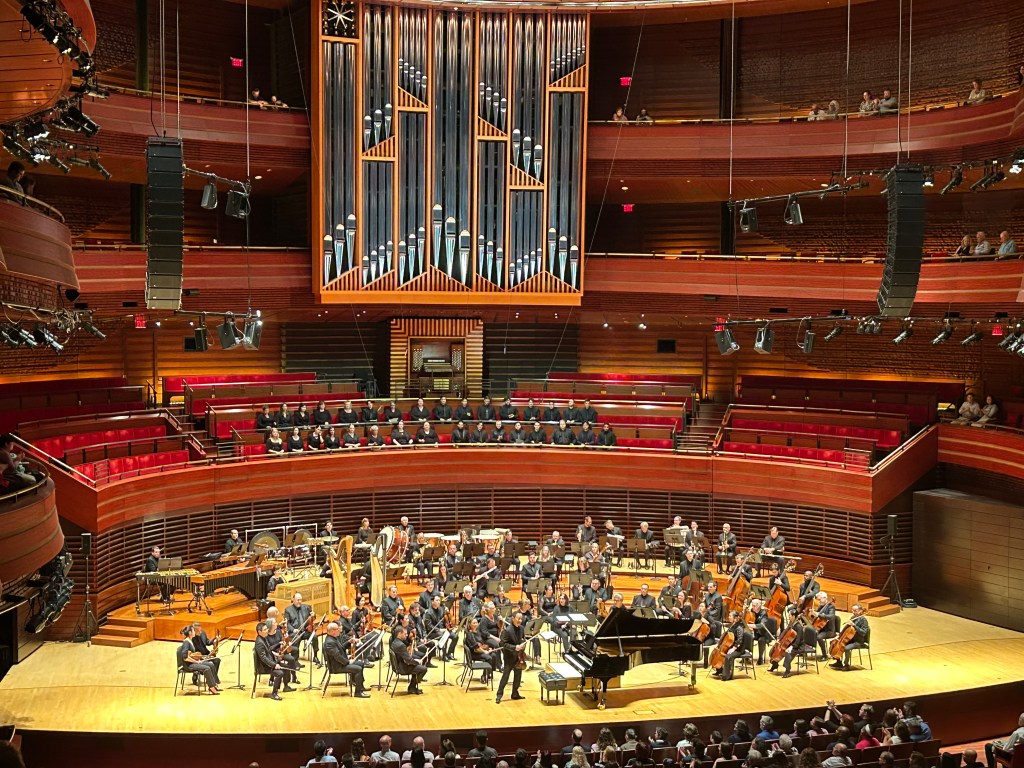
The Philidelphia Symphonic Choir joined the Orchestra, along with soloists Jean-Yves Thibaudet (Piano), Maya Beiser (Cello), and Gil Shaham (Violin).
The evening started off with an introduction by M. Night Shyamalan pointing out that the heart of a film is the score, a “second script” that can make or break a film. The “truth” of the characters’ personalitites is “conveyed through his music.”
Three selections from The Sixth Sense started out the concert: Lonely Boy, Ghost in the House, Acceptance. Prior to the concert I did not notice how few of the orchestra members Howard needed to create his sweeping emotive phrases. Throughout the concert his works would highlight various instruments. He used the oboe, flute, timpani, piano, and violin most often.
Hearing the album first gave me greater appreciation for the Philadelphia Orchestra’s prowess. They displayed a greater breadth of tone and color than the first call Sony orchestra album that supported famous soloists. Their climatic moments came like ocean waves, sweeping in and with a force simultaneously intimidating and emotive.
James Newton Howard conducted the orchestra in a very conservative, easy to follow, classic style. For the next few scores, he asked Philadephia Orchestra assistant conductor Naomi Woo to handle the baton. The orchestra responded well to her more modern, precise style. Though it lacked the personality and flare of Yannick, I found it pleasantly comforting and easy to follow.
A couple notes that could have improved the evening’s performance. The strings, percussion, and woodwind sections displayed the exact synchronisticity we have come to expect at Marian Anderson Hall. At a couple moments during the Signs and Lady in the Water suite, the choir did not maintain the same precise timing as the orchestra. The brass section was a bit thin and indecisive compared to their usual punch. This may have been because they only brought a skeleton crew of about six to cover the material.
I think we as an audience missed the opportunity for an encore prior to intermission with Maya Beiser, as our applause died out quicker than usual. The pieces, though beautiful and played skillfully did not require the same instrument mastery as say, a Chopin Prelude; this may have contributed to our response.
After intermission, we enjoyed selections from The Village. Hiliary Hahn played the solos on the original score. Her performance remains the standard for me, yet Gil Shaham provided a beautiful interpretation. His approach took off some of the edge and urgency of the original, allowing the piece to breathe with the vibrado without slowing down the score. Less piercing than Hahn’s performance, his approach soothed the soul and portrayed the gentle strength of the movie’s main character, Ivy.
The composer and director sat down to talk about the nature of film scores in our time and how that has changed over the course of the career.
While the concert lacked the standard gravitas of most of these concerts, I loved the intimacy of a “behind-the-scenes” approach to some fantastic musical scores. We would go again if given the choice, which is a testament of the fantastic skill of the orchestra.
We are looking forward to a brand new season with The Philadelphia Orchestra, as there is so much in store. To learn more about it and upcoming performances, visit them online.
*we were invited to facilitate a feature, all opinions are our own.*

 the mommy avenger
Leave a comment