Matinees have an interesting reputation.
At the movie theater, it’s a way to see the exact same film for about a third of the price, as long as you are willing to endure the parents with noisy small children and the talkative high schoolers cutting class.
In the classical arts, a matinee performance is often the equivalent of watching a preseason baseball game. You may get some of the same performers, or the coach may be testing out a new line ups and giving some of the second string a chance to shine. Rarely do the same artists perform in the afternoon and then in the evening. It doesn’t always mean that the performances at a matinee are inferior, but more often than not, our afternoon experiences with the arts have left us feeling that we missed out on something better.
When we saw that the Saint-Saëns’s Organ Symphony schedule only consisted of two matinees, we raised an eyebrow—not enough to prevent us from procuring seats, but enough to indicate our hesitancy. We wondered if Yannick did not want to compete with a potential Philadelphia Phillies postseason (Rest In Peace 2024 Phillies. Who would have known that the Mets could beat you in five games? Would you prefer lemon juice or salt for that open wound?).
Imagine our joy when we learned that the concert would include a viola concerto by Philadelphia Orchestra’s own Choong-Jin Chang, the principal viola since 2006, Julliard graduate, and teacher of many other members in the orchestra. I was not familiar with Martinů’s Rhapsody-Concerto for violin and orchestra prior to this concert. This piece moved with serene beauty and harmony.
I appreciated the way the orchestra and soloist matched each other’s tone, color, volume, and feel. Chang played with a sublime touch that reminded me of Hemingway’s writing; profundity without dramatic show, which I prefer to extreme contortions in such a piece.
Yet I have gotten ahead of myself; the concert began with a dissonant piece full of urgency known as The Marvelous Mandarin by Bartók. Our guest conductor Mr. Roderick Cox matched the tone with clear and sharp directing. His style left no doubt about his expectations of the orchestra and they stepped up to his requests with ease. I found his direction emotive yet precise, increasing the quality of my listening experience. I found his conducting more interesting than the piece.
The music itself seemed to borrow heavily from Holst, Copeland, Bernstein, and others, with a touch of the late golden age of Hollywood. For me it was more derivative than original.
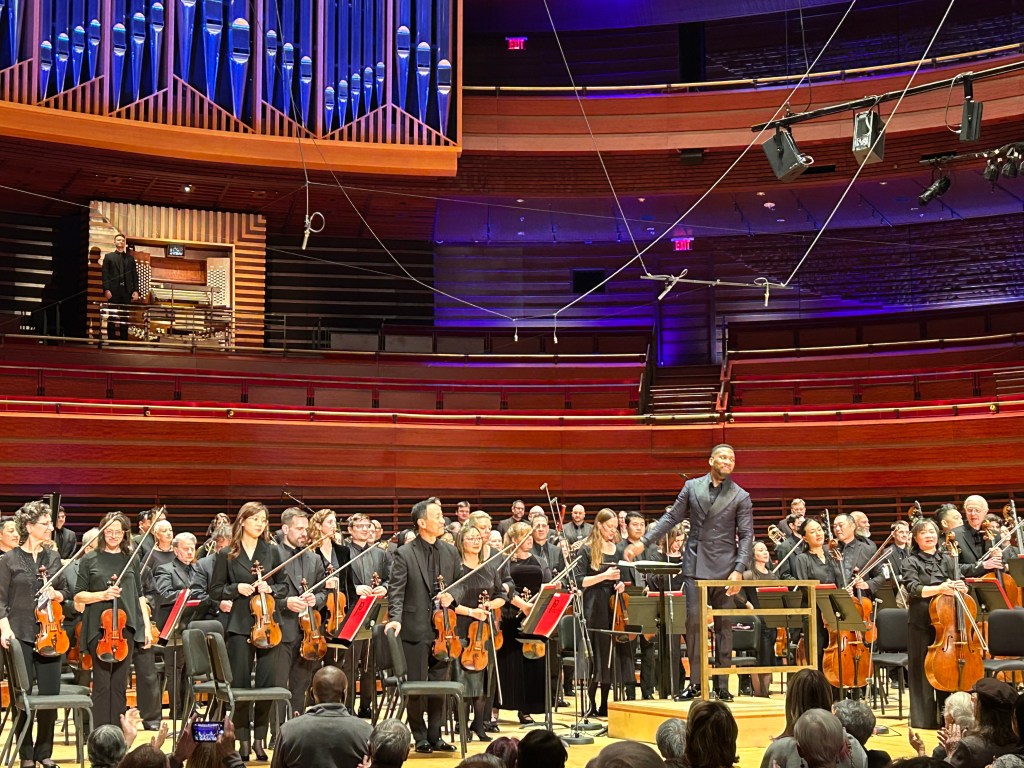
The musicians appeared in top form with all sections locked in more than I have heard yet this season. That also made the piece more enjoyable than it would have been without such orchestral mastery.
After the intermission, we were treated to Saint-Saëns thematic symphony. He dedicated this to Liszt, who originated the idea of an organ symphony.
The orchestra continued playing with the glorious precious, great swells, brilliant diminutive sections and deft touch. If I was hearing this blind, I would have thought Yannick was conducting, they played that well. That is my highest praise for guest conductor Mr. Cox.
The piece itself had everything one would want in a symphony that played as a greatest hits album from the romantic era. Touches of known themes, nods to great composers, and Saint-Saëns skill at smooth transitions as well as emotional highs and lows coming rapid succession.
This performance had everything I would want in a sellout evening performance, but perhaps I am living in the past and I need to let go of my concert time-ism and just recognize greatness regardless of performance time.
To get tickets to another performance by the Philadelphia Orchestra scheduled this weekend, visit them online.
*we were invited to facilitate a feature, all opinions are our own*

 the mommy avenger
Leave a comment