Like berries with lemon, grapes and cheese, caramel and cashews, or peanut butter and chocolate, some pairings should be tasted often. The concert pairing of Yannick Nézet-Séguin and Hélène Grimaud at the Philadelphia Orchestra is one of the great modern duos. There is a bespoke creative spark and interplay when these two collaborate that feels intimate while demanding the audience not blink or they will miss a certain je ne sais quoi.
At first glance, this can almost seem surprising to those with classical training. One look at the pieces that Hélène Grimaud gravitates toward, and one may be tempted to shake their head in wonder. She often chooses the deeply German or Austrian composers. Matching the same repertoire as bombastic pianists known for their intensity, volume, speed, and strength such as Vladimir Horowitz and Sergi Rachmaninoff — Individuals who command respect due to their power. Looking at Grimaud before hearing her play can feel a little like seeing a 5’3” Muggsy Bogues in the NBA, or a seventy-five pound freshman handling the tuba in a marching band. One expects it to go comedically.
Then she begins to play. Her command of a nine foot Steinway Grand can rattle the hall and leave the frail reaching for their heart medications in order to experience the concert. Yet, she can transition with fantastic speed to the pensive pieces that lean more on the late romantic sensitivities before returning to the grandiose, forceful moments of might, weight, and vigor.
Brahms’ Piano Concerto No. 1 in D minor immediately warns listeners there will be sweat on the concert floor, maybe not literally, but the piece demands much of the musicians and the audience in order to follow the movements and the information being passed between pianist and orchestra, percussion and strings, or brass and woodwinds. This piece is the musical equivalent of a HIIT (high intensity interval training) workout. There are brief respites to regain one’s breath followed by magnificent sprints and lifts of musical genius.
Tonight this pair put on a show.
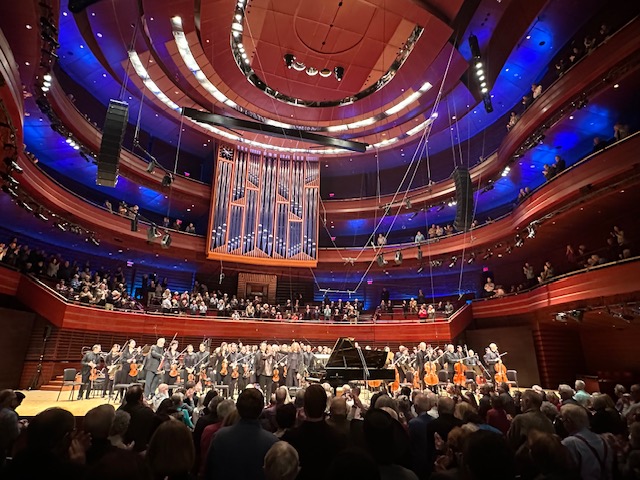
Yannick drew perfection from the symphony like Fantasia’s magician conductor as Hélène’s fingers danced up and down the ivories, at times strong and graceful like a ballerina and others more like the strength from a B-boy the speed of a jig, or the energy of clogging. Just beautiful to see the play between conductor and pianist. The smiles exchanged throughout expressed an appreciation for what the other was contributing.
It was fantastic.
Oh, and before the main course we sampled two other works. A Philadelphia Orchestra co-commission “Pretty” by Wolfe. I am surprised they did not save this piece for October.
It contained all the frenetic controlled chaos of an excellent thriller film score. Pretty with a rhythmic layering of strings and accents of percussion, followed by rolling crescendos and de crescendos, fading to pianísimo and coming in again at forte. The dissonant brass haunted the audience like the run through the forest in an M. Night Shyamalan movie. The orchestra handled the piece with their signature precision like any other work. The synchronized bowing, dynamic control, and energy enhanced the speed of the concert master’s solos while the other violins became percussionist, only to be followed by the cellos and basses, with brass providing the accents.
As always, a pleasure to watch Yannick bring such a piece to life with enthusiasm, command, and even some swagger. The composition layered sections well, giving each section opportunities to shine. The audience gave mixed reviews with their applause, not because of the performance, but because of the piece. Some gave it a standing ovation and Yannick returned for a second bow while others waited patiently for the night to continue.
Then they played Farrenc’s Symphony No. 1, which was not as contrasting from the first as one might expect. It was filled with dynamic control, line upon line of 16th notes, and a play back and forth between sections. With a brooding cello beginning, and traditional variations on themes, Farrenc’s first symphony gets lost sounding like many other classical works. It almost seemed like the type of piece I would expect AI to create, hitting various points and sounding fine, but not inspired.
Following the standing ovation, Hélène treated the audience to a another two rounds of bows and gratitude before exiting the final time.
Do you have children, friends, or ignorant relatives who think classical music is boring? Schedule their visit to Philidelphia to coincide with Yannick and Hélène’s next performance (whenever that may be) and don’t miss out.
There are two more performances of this event playing this weekend, so secure tickets if you can!
*we were invited to facilitate a feature, all opinions are our own*


 the mommy avenger
Leave a comment