
How does one rise higher when already standing atop a mountain?
When an ensemble is already considered one of the finest in the world, what becomes the new summit?
Those questions lingered in my mind as I made my way to Marian Anderson Hall to hear the Philadelphia Orchestra.
I concluded that greatness, once attained, must evolve: from being the best of their time to delivering performances that might stand as the definitive interpretations for all time. A daunting challenge, especially when the work in question is as monumental and beloved as Beethoven’s Ninth Symphony—a masterpiece famously completed when the composer was entirely deaf.
Some of the most iconic recordings of this symphony are steeped in profound historical and cultural context. Take, for example, Wilhelm Furtwängler’s 1951 Bayreuth Festival recording—a performance often heralded as the most intense and socially- charged ever captured. Coming in the wake of World War II, it was more than music; it was catharsis, a symbolic resurrection of art from the ashes of devastation. That audience wasn’t merely attending a concert; they were participating in a collective healing.
So how does one compete with that—on an ordinary Thursday night in Philadelphia?
In short: very well. This may be the most deeply moving and technically magnificent performance in decades.
Before that, the evening began with Florence Price’s “Piano Concerto in One Movement,” a work echoing with the rich undertones of spirituals and folk idioms. Price’s mastery of form and harmony is evident throughout the concerto’s 18-minute span. It builds with subtle intensity, weaving sweeping passages with moments of delicate introspection.
And yet, something felt slightly off. At first, I suspected the piano might be out of tune. Then perhaps it was the pianist’s touch. Finally, I realized—it wasn’t the playing at all, but the instrument itself: a Yamaha, rather than the Steinway & Sons concert grand that normally graces the stage. While sponsorships are understandable, this choice slightly altered the tonal warmth I’ve come to expect at these concerts. Still, the performance was admirable and one I look forward to revisiting when it’s rebroadcast on WRTI radio this Sunday at 1 p.m.
Then came Beethoven’s Ninth.
From the opening bars, it was clear: this was a performance balanced on a razor’s edge—executed with surgical precision yet bursting with barely contained passion. The tension and urgency Yannick Nézet-Séguin brought to the interpretation made it feel like the orchestra was holding back an emotional flood until the final movement. Each phrase was smooth and deliberate, yet always threatening to erupt. It was, without question, the most electrifying live performance I have witnessed, and I have seen AC/DC live.
The soloists and chorus were equally commendable. Their clarity, energy, and cohesion matched the orchestra’s intensity. The choral finale, “Ode to Joy,” soared—not as a cliché, but as a genuine expression of exultation.
Special praise must go to the string section, which played with such unity that they felt like a single instrument. And Don S. Liuzzi on timpani? A percussive ninja, every strike exact in placement, volume, with tonal weight.
Of course, much of this excellence flows from the top. Yannick Nézet-Séguin has built something truly remarkable in Philadelphia: a culture of excellence, consistency, and artistic risk-taking that continues to justify our two-hour commute to attend.
Of course the evening ended with a lengthy standing ovation from the filled music hall.
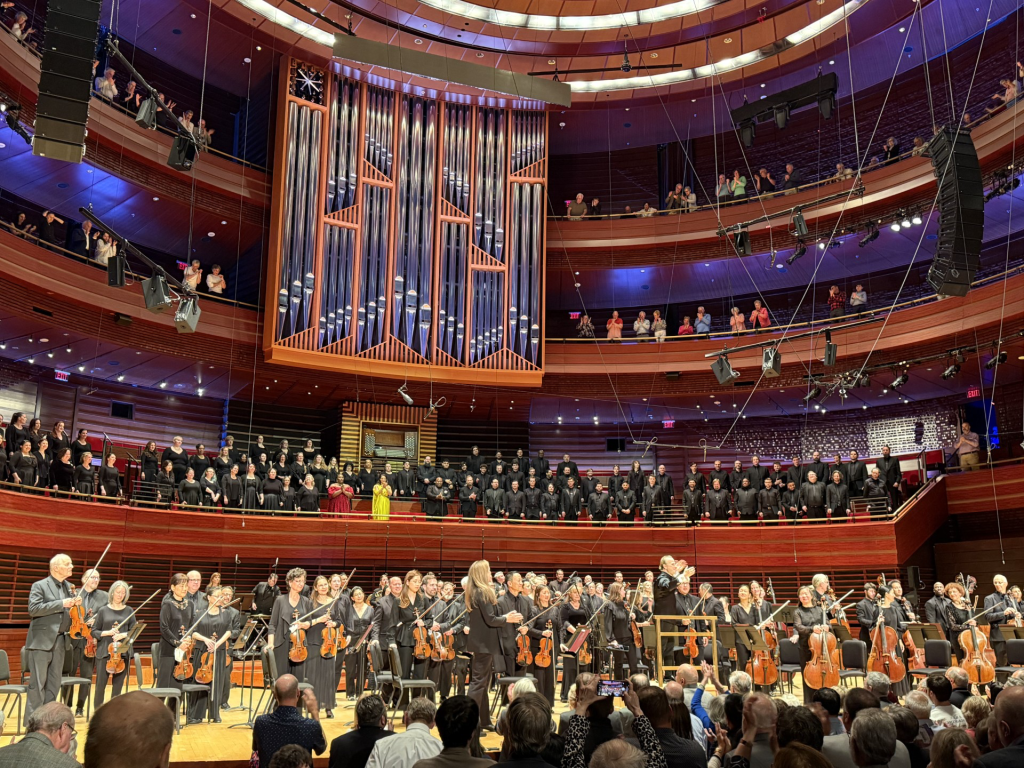
Before you go, take time to attend the pre-concert lecture series—always informative and often enlightening. And for more unforgettable evenings, explore their newly released 2025–26 season on the Philadelphia Orchestra’s website.
This ensemble is not just sustaining excellence; it’s redefining it.
*we were invited to facilitate a feature, all opinions are our own*

 the mommy avenger
Leave a comment