
As the 2024-2025 season draws to a close, the Philadelphia Orchestra once again leaves us longing for more. Their final performance, The Grand Finale, was a testament to their artistic evolution—refined, resonant, and emotionally stirring.
At the end of last season, I described the orchestra to a friend as: “beautiful precision.” This year, under the continued leadership of Yannick Nézet-Séguin, that precision remains—but now enriched by a deeper sense of emotional urgency. Their sound has matured not just in technique, but in expressive power, shaped by an ever-deepening understanding of their conductor’s vision.
This evening’s program was an intriguing departure from the usual fare: all three symphonic works were composed in D major, an unusual thematic choice that at first seemed like it might offer the orchestra a gentle send-off. How mistaken I was.
The concert opened with a gem from the early Classical period: a symphony by Joseph Bologne, Chevalier de Saint-Georges. Often underrepresented, this piece was a sparkling reminder of his elegance and form. The orchestra captured its courtly grandeur with smooth poise, evoking the regal salons and ballrooms of a PBS period drama.
Next came Prokofiev’s Classical Symphony. This composition is technically demanding particularly notoriously taxing piece for the woodwinds. The orchestra tackled its rapid-staccato passages and witty self-references (including nods to his own Romeo and Juliet) with spirited brilliance. Far from a reprieve, it was a sprint through Prokofiev’s neoclassical labyrinth, executed with thrilling vitality.
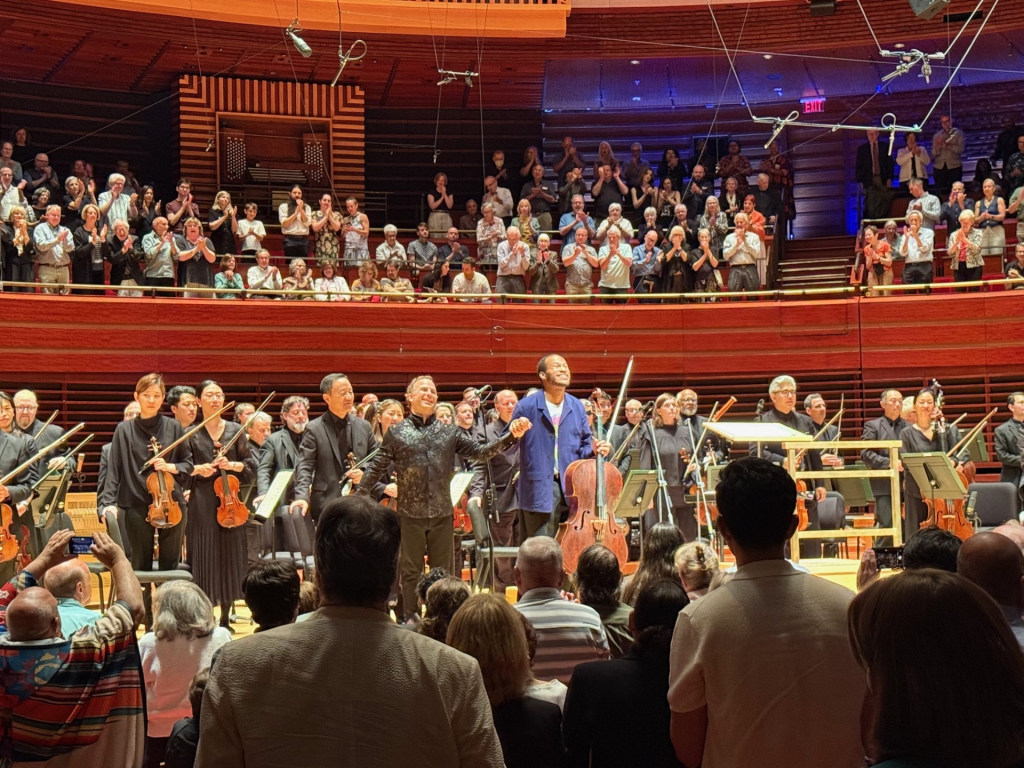
After the intermission, the orchestra celebrated individuals who are retiring (Obad Bar-David, Jeffrey Curnow, Kiyoko Takeuti) and those who have played for twenty five years (Jason DePue, Daniel Matsukawa) with the orchestra. They also gave out the Kuhn award for the orchestra member who raised the orchestra’s level of quality.
The final work on the program (though second in historical chronology) was Mozart’s Symphony No. 35, the Haffner, placed last perhaps because of its sheer popularity and exuberance. Here, the orchestra illuminated Mozart’s brilliant textures—graceful with piercing accuracy. The symphony’s final movement was a fitting end, and the ensemble handled it with nimbleness and polish in spite of obvious fatigue from the longer concert.
In the middle of the program came a dark foil: Shostakovich’s Cello Concerto No. 1, in E-flat major—just a half-step away from D, yet a world apart in mood. If D major is the key of triumph, of royal marches and joyful fanfares (the same key as the modern rock song: “Twist and Shout”), then E-flat here became its brooding shadow, ready to stab anyone fool enough to turn down this dark alley of a key signature. This piece introduced a different kind of emotional urgency: darker, restless, and introspective. It would feel perfectly at home on a Halloween concert program alongside Night on Bald Mountain.
Soloist Sheku Kanneh-Mason delivered a riveting performance, full of tension and nuance. His interpretation continues to evolve, and it’s a joy to witness his artistic voice grow more distinctive with each return to Philadelphia. I felt this piece did more to demonstrate his extreme command of the instrument rather than appease the masses with lyrical beauty.
A special shout out must be given to horn player Jennifer Montone, whose demanding role in the concerto was performed with stamina and soul—her contributions were nothing short of heroic, and without her, the performance would have come across a bit anemic.
I preferred his solo, which seemed like a classical lullaby of sorts.
This evening’s program was a brilliant capstone to a season that has defined itself by balance: technical excellence tempered by emotional depth. The Philadelphia Orchestra ends its season not only as masters of their craft but as bold interpreters of the human spirit. One can only imagine—with excitement—where they will take us next in their 125th season.
You know we will be back for more, and you should join us. Tickets are on sale now. In the interim, tune in Sunday afternoons at 1 p.m. EST to WRTI.org for recordings of past performances.
*we were invited to facilitate a feature, all opinions are our own*

 the mommy avenger
Leave a comment