
Hilary Hahn has been playing the violin for more than 42 years. At age ten, she was admitted to the Curtis Institute of Music in Philadelphia. By twelve, she was performing with major orchestras, including Philadelphia Orchestra, Baltimore Symphony Orchestra, Cleveland Orchestra, Pittsburgh Symphony Orchestra, and the New York Philharmonic. Before sixteen, she had made her international debut.
Since then, she has released 23 albums as a featured artist, earned three Grammy Awards, recorded three DVDs, and served as soloist for the Oscar-nominated score to The Village. I first became aware of her artistry through that film, and its accompanying recording remains one of my two favorite film soundtracks of all time. She has received nearly every major accolade available to a professional violinist.
Known for her disciplined practice regimen and exacting musical standards, she has continued to refine her artistry, technique, and influence, establishing herself as one of the leading classical violinists of our time. She now serves as a visiting artist at Juilliard School.
Then came a series of serious health complications. Years of repetitive motion, travel, and performance led to a double pinched nerve, muscle atrophy, and a herniated disc requiring cervical spine surgery. For two years, she endured nerve compression and chronic pain, halting her touring schedule and severely limiting her ability to practice.
On February 8, 2026, she reported that she was finally pain-free.
Tonight is February 12, 2026—her first concert since that hiatus.
Having seen her perform multiple times before, we arrived keenly aware of her extraordinary capabilities in her prime. We tempered our expectations, mindful that time spares no one. Then we noted the evening’s featured concerto.
Sergei Prokofiev’s Violin Concerto No. 1 is notoriously demanding, often ranked just below the formidable concertos of Johannes Brahms, Pyotr Ilyich Tchaikovsky, and Jean Sibelius in technical difficulty. The left hand must move with agile precision at high speeds while maintaining impeccable intonation through extensive chromaticism. The bowing requires rapid leaps interspersed with passages of great delicacy and lyricism.
The evening opened with Pyotr Ilyich Tchaikovsky’s Capriccio Italien. This accessible work blends tuneful melodies with colorful orchestral flourishes, particularly in the horns. It is among the least brooding of Tchaikovsky’s compositions. Absent is the shadowed melancholy that undergirds works such as Swan Lake. Instead, the piece radiates brightness and charm—perhaps reflecting a rare period of relative ease in the composer’s life.
Our Finnish guest conductor, Santtu-Matias Rouvali, is among the most sought-after artists on today’s podiums. Known as a “performer’s conductor,” he led with an ideal balance of economy and clarity—minimal extraneous movement, yet absolute precision in gesture. It was one of the most satisfying conducting displays I have witnessed in recent seasons. His style never fatigued the audience; rather, it communicated with such simplicity and transparency that one felt fully aware of what was unfolding at every moment. While Yannick Nezet-Seguin often maintains a tighter precision through his deep rapport with the orchestra, I hope the Philadelphia Orchestra will invite Rouvali back frequently.
Prokofiev was reputed among his contemporaries for his biting wit, and some have speculated that his compositions expose performers’ weaknesses as much as they showcase their strengths. This concerto leans less on shock or acerbic neo-classicism and more on emotional weight and atmospheric tension.
It is one of Ms. Hahn’s signature works, and her command of it was evident in the smallest details—the subtle preparation of the bow before a pizzicato passage, the strength and control in extreme upper positions, the immaculate articulation of rapid runs. Her mastery of the score remains formidable.
That said, she appeared more grounded than in earlier years. In the opening minutes, she seemed intent on settling into her chosen tempo, but within five minutes any residual caution had vanished and she was fully immersed in the concerto’s language. If time has moderated her more flamboyant physical gestures, nothing essential has been lost. With eyes closed, the listener encountered the same clarity, intelligence, and tonal beauty that have long defined her playing.
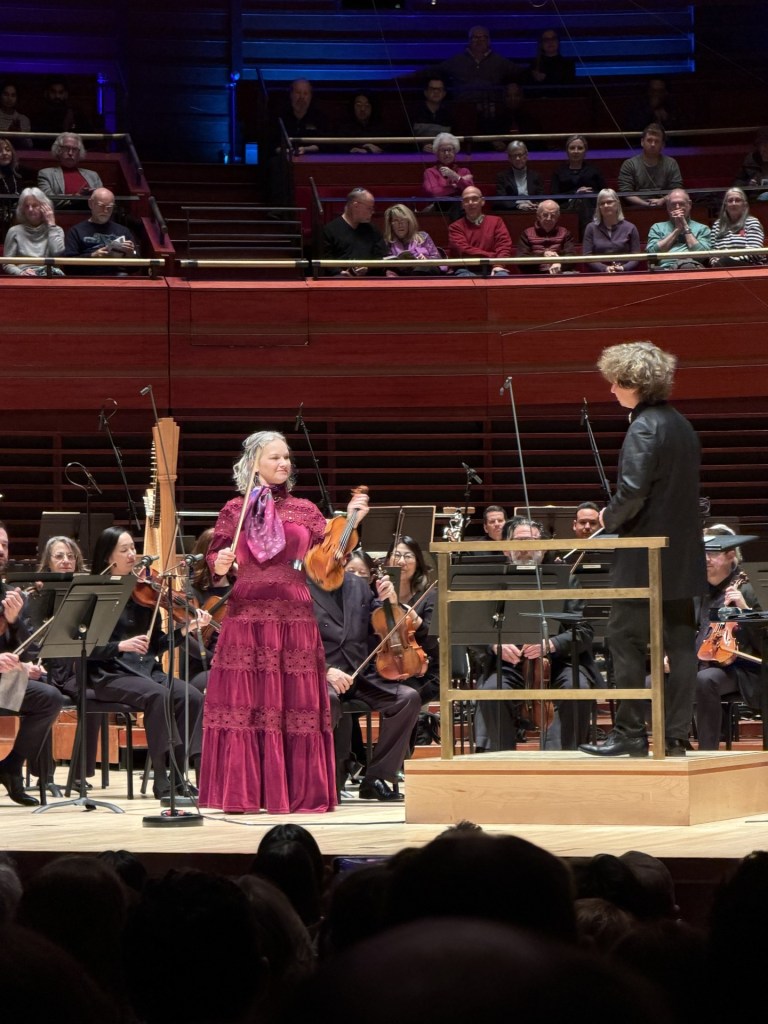
Her encore appeared to be drawn from the contemporary repertoire she so ardently champions. The audience responded politely, though with less enthusiasm than for the concerto—an unfortunate reaction, as the piece revealed another dimension of her artistry: restrained, contemplative, and philosophically poised. It served as a thoughtful counterbalance to the evening’s larger works.
The program concluded with Dmitri Shostakovich’s Symphony No. 6, a work seldom performed. The composer described it as embodying spring, joy, and youth—an assessment seemingly at odds with its dark, introspective first movement. The second and third movements pivot abruptly toward exuberance, the finale almost manic in its brevity and frenetic energy. Yet perhaps this contrast captures the volatility of youth itself.
Under Rouvali’s direction, the orchestra embraced this interpretation wholeheartedly. The strings, woodwinds, and horns appeared entirely at ease with his communicative style, responding with precision and vitality.
The Philadelphia Orchestra has an unfortunate habit of spoiling other concert experiences. Its depth of sound, cohesion, and technical excellence consistently set a standard few ensembles can match. Tonight was no exception. Listen for yourself on Sunday afternoons on WRTI, or experience the real thing in person. The 2026-27 season has just been announced, and ticket packages are now available.
*we were invited to facilitate a feature, all opinions are our own*


 the mommy avenger
Leave a comment